
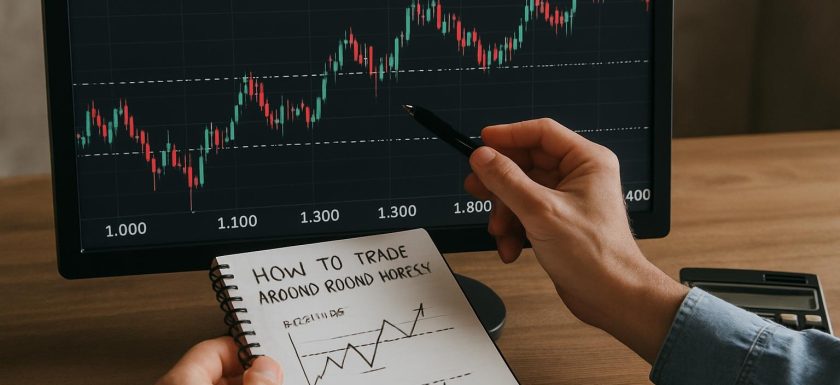
Understanding Round Numbers in Trading
In the realm of financial markets, round numbers such as 100, 1000, or even 10,000 often serve as psychological barriers. These numbers are not arbitrary; they carry a psychological weight among traders and investors. It’s crucial to understand that these numbers can significantly influence trading behaviors and market dynamics.
The Psychological Impact of Round Numbers
Round numbers are easily remembered and are psychologically satisfying targets for traders. This phenomenon, sometimes referred to as “price clustering,” occurs when traders place buy or sell orders around these numbers. As a result, round numbers often represent areas of significant price resistance or support. Understanding this concept is essential for traders looking to enhance their strategies using technical analysis.
The mastery of trading often includes grasping the more subtle, yet equally impactful, aspects of market psychology, such as the collective impact of round numbers. When large groups of traders and investors focus their decisions around certain numerical points, such as round numbers, these points become self-fulfilling focal points. It’s not uncommon for a round number to act as a magnet for prices, drawing them in but then either pushing them away in reflex (as a resistance) or bouncing them back (as a support), thereby creating observable and sometimes predictable patterns within the chaos of the markets.
Support and Resistance Levels at Round Numbers
Positioning themselves by understanding how round numbers can act as support and resistance levels, traders can anticipate market movements more strategically. Round numbers often act as psychological barriers where the price of an asset might struggle to break through. For example, if the price of a stock approaches a round number, it may frequently halt there, leading to what is identified as a resistance level. Conversely, when the price is falling, these numbers can act as support levels. Repeated tests of such a level can indicate its significance, as each test without a breakthrough reinforces the round number’s role as a barrier.
Traders can utilize these levels to identify potential entry and exit points. When the price consistently bounces off a round number, it reflects a level of either support or resistance. Traders can then position themselves accordingly, buying near the support and selling near the resistance. This recognition allows for targeted entry and exit points that align with a trader’s risk management strategies, enhancing the predictability of outcomes and improving overall trading efficiency.
Incorporating Technical Analysis
Technical analysis involves using historical price data, including patterns and indicators, to make informed trading decisions. When integrating technical analysis with the concept of round numbers, traders can increase the effectiveness of their strategies.
Using Candlestick Patterns
Candlestick patterns provide valuable insights into market sentiment and can be used alongside round numbers to predict future price movements. For instance, if a hammer candlestick pattern forms at a round number, it may signal a potential reversal. Traders may interpret this as a buying opportunity if the market is at a support level. The identification of such patterns requires a nuanced understanding of candle formations and the corresponding market emotions they represent. Always consider the context of these patterns, as their implications can vary depending on the prevailing market trend and other coinciding indicators.
Moving Averages and Round Numbers
Moving averages can also be used in conjunction with round numbers. When a moving average coincides closely with a round number, it can create a stronger level of support or resistance. Traders often view these confluences as significant, potentially leading to sizeable market movements. The integration of moving averages provides a layer of corroboration, helping traders filter out noise and confirm the validity of the signals they observe at these key psychological price points. In this setup, a moving average enveloped around a round number can provide a guide map to stronger trading signals that merge technical precision with psychological barriers.
Strategies for Trading Around Round Numbers
When trading around round numbers, it’s essential to incorporate strategies that maximize potential gains while minimizing risks. The process begins by translating the psychological understanding of round numbers into actionable trading strategies.
Breakout Trading
Breakout trading involves entering the market when the price breaks a round number with significant volume. Traders often set orders slightly above or below these levels to capture potential movements. It’s crucial to monitor the volume closely, as a genuine breakout accompanied by high volume is more likely to lead to sustainable price movements.
In breakout trading, accurate assessment of volume alongside price movements assures the trader about the breakout’s authenticity. Poor volume could indicate a false breakout, while substantial volume suggests institutional participation, thereby supporting the likelihood of a continuous price trend. Preparing for such events requires both technical preparation and the mental fortitude to act when the breakout level is breached.
Reversal Trading
Reversal trading is another strategy where traders anticipate a reversal when the price hits a round number repeatedly. This approach requires a keen understanding of market indicators to identify potential reversal points accurately. Traders may use oscillators like the Relative Strength Index (RSI) or Stochastic Oscillator to gauge whether an asset is overbought or oversold.
By analyzing these indicators at pivotal round numbers, traders can be better positioned to anticipate market exhaustion or price reversals, allowing them to time their trades to capitalize on these market shifts. The successful application of reversal trading often depends on a thorough analysis of the market’s broader trend structure and internal momentum indicators.
Conclusion
Trading around round numbers using technical analysis requires a deep understanding of market psychology and technical indicators. By recognizing the psychological impact of round numbers and incorporating technical analysis tools, traders can make more informed decisions. While there’s no guaranteed success in trading, these strategies offer a structured approach to navigating the complexities of financial markets. For further reading on technical analysis techniques, several financial education platforms provide extensive resources. Always ensure you’re using trusted sources when expanding your knowledge base. As the trading landscape evolves, the ability to adapt and refine strategies around constants like round numbers will continue to be a valuable skill set for any astute market participant.
This article was last updated on: August 14, 2026